Overview
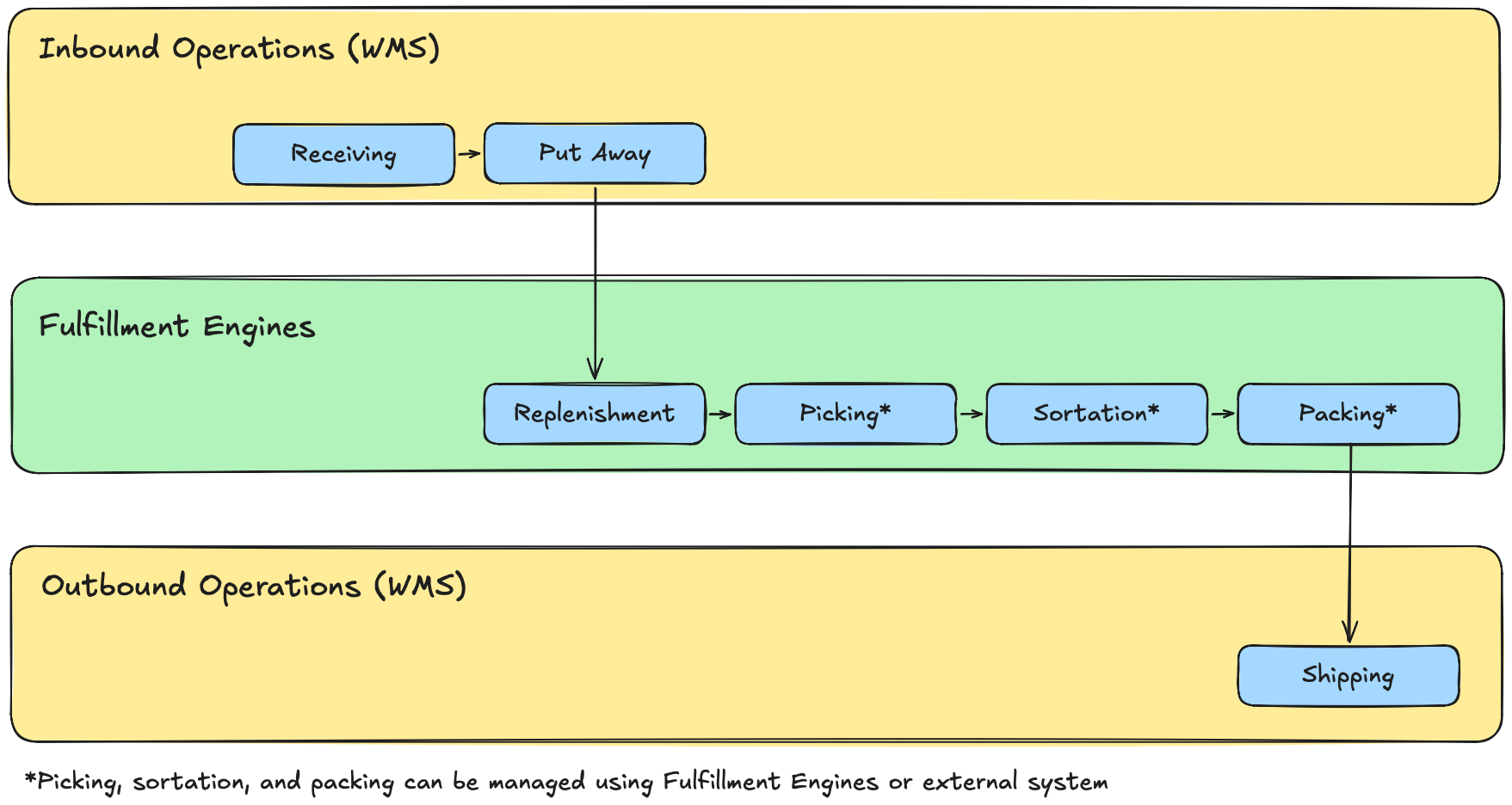
Fulfillment Engines replenishment helps you optimize orchestration of waveless replenishment. You can use Fulfillment Engines replenishment with either waveless or wave-based fulfillment operations.
What challenges do traditional and wave-based warehouse systems have with replenishment?
Traditional and wave-based warehouse systems struggle to optimize replenishment operations for a variety of reasons, including:
Disconnected replenishment and fulfillment operations
Traditional and wave-based warehouse systems treat replenishment and fulfillment operations as two separate, isolated processes. Unfortunately, replenishment and fulfillment are tightly interdependent. Pickers cannot pick inventory that has not been replenished in time. And what SKUs to prioritize for replenishment is heavily dependent on the set of activated and soon-to-be-activated orders.
Inflexibility
Traditional and wave-based tools rely on pre-determined plans to manage replenishment. These plans can get out of sync with reality quickly and continue diverging with conditions on the floor as the day goes on. Wave-based warehouse management systems (WMS) and warehouse execution systems (WES) struggles to adapt plans in real-time due to all the interdependencies across the replenishment and fulfillment processes. Which SKUs to prioritize for replenishment and worker task assignments are all pre-determined and either cannot be or are very hard to change once a wave begins.
Late replenishments
Wave-based systems operate on fixed batches of orders. For each batch, the warehouse management system (WMS) calculates what inventory must be replenished in the forward area to meet the demand for the orders in the batch. The WMS then creates a plan to first execute all the required replenishments and then activate the orders for picking. Many WMSs try to reduce order processing times by activating orders for picking before the prerequisite replenishment tasks complete by using an estimate of when the task is expected to be done. However, if a forklift operator or runner is unable to complete a replenishment task in the expected time due to mechanical or stock issues, there is risk that the inventory will not arrive in the forward picking area before the picker gets to the pick location for the needed SKU. This creates a late replenishment exception. When late replenishments happen, processing for all the orders in the current and subsequent waves can be delayed, or a supervisor must manually force complete the wave and send the affected orders to a hospital area to work around the late replenishment.
Slow processing of hot orders
Because wave-based systems operate on pre-determined, fixed batches of orders, wave-based replenishment must wait to process replenishment tasks for hot orders until the next wave begins (at the soonest). Waiting to complete the replenishment tasks for a hot order until a future wave delays processing and risks missing critical packing or shipping deadlines.
Reactive exception detection
Wave-based systems are designed to execute fixed plans. When unexpected delays or issues prevent workers from following the plan, the worker must create an exception, and a supervisor must investigate the issue and determine a solution. This reactive approach to exception detection and resolution creates bottlenecks and delays in replenishment and fulfillment operations.
Supervisor decision fatigue and bottlenecks
Most WMS and WES tools offer real-time visibility via dashboards, but supervisors still need to synthesize the data quickly on their own to make dozens of time-sensitive decisions to resolve issues quickly and keep operations on track. On top of investigating exceptions, tracking facility performance and operational risks, supervisors are also responsible for figuring out how to prioritize replenishments to meet order deadlines, when and how to move people between functional areas, and how to deal with orders blocked by late replenishments. Putting all these low-level tactical decisions on supervisors creates operational bottlenecks and facilities that are reliant on tribal knowledge and bespoke processes.
Bottleneck waveless fulfillment
For retailers and 3PLs using waveless fulfillment, a common cause of late orders is late replenishments. Many wave-based replenishment systems struggle to match the throughput velocity of waveless fulfillment systems and become the bottleneck of the operation.
What are the benefits of Fulfillment Engines Replenishment?
Unified view of fulfillment and replenishment
Fulfillment Engines was designed from the ground up to take a holistic view of fulfillment and replenishment. Fulfillment Engines Order Fulfillment monitors task progress continuously to carefully and safely orchestrate actions to proactively avoid exceptions and unnecessary delays. On the replenishment side, Fulfillment Engines Replenishment continuously monitors order priority and which orders are due for activation soonest to decide how to prioritize replenishment tasks to avoid processing delays.
Real-time flexibility and agility
Fulfillment Engines Replenishment operates on dynamic batches of orders. Fulfillment Engines monitors upcoming orders for activation continuously and intelligently triggers replenishment tasks in anticipation of the upcoming demand. This approach allows Fulfillment Engines to provide your operation greater flexibility and agility to adjust replenishment and fulfillment tasks based on real-time conditions in your facility. If inventory is unexpectedly late, lost, or damaged, Fulfillment Engines can take immediate action to re-trigger replenishment tasks to keep urgent orders processing and avoid unnecessary delays. There is no need to wait for a future wave.
Reduced risk of late replenishment issues
With Fulfillment Engines, replenishments for upcoming orders are always triggered before the orders are activated. Its waveless, continuous flow orchestration does not require activating orders in anticipation of replenishment to reduce processing times. Instead, replenishment lead times are relatively stable and adjusted by the system automatically based on the real-time throughput of the facility. Once a replenishment is triggered, Fulfillment Engines Order Fulfillment monitors replenishment progress continuously to ensure replenishment tasks are completed before workers are sent to any pick location awaiting replenishment to prevent late replenishment exceptions.
Immediate processing of replenishments for hot orders
Fulfillment Engines Replenishment operates on dynamic batches. Using dynamic batches allows Fulfillment Engines to trigger replenishments for hot or upcoming orders faster. Rather than waiting for the next wave to trigger replenishment for a hot order, Fulfillment Engines can trigger replenishment for the hot order as soon as a worker becomes available.
Proactive exception detection and resolution
Fulfillment Engines Replenishment proactively detects and resolves many common types of replenishment exceptions in real-time automatically, including working around damaged inventory and user errors. Faster detection means exceptions can be fixed faster by the software, without waiting for a supervisor or delaying orders. Fulfillment Engines Replenishment uses waveless orchestration to isolates the impact of exceptions and avoid unnecessary delays.
Frees up supervisor time by offloading dozens of tactical decisions
Fulfillment Engines offloads dozens of tactical decisions from supervisors to save time, remove process bottlenecks, and reduce supervisor’s administrative overhead. In addition to orchestration of routine replenishment tasks to keep the facility moving on-time, Fulfillment Engines helps supervisors maintain productivity and work around unexpected replenishment issues such as replenishment delays, missing or damaged inventory, and user errors (e.g., incorrect location scans).
Designed to work with waveless fulfillment
Fulfillment Engines Replenishment helps you realize the productivity and efficiency potential of waveless fulfillment by removing replenishment as a bottleneck. It not only works seamlessly with Fulfillment Engines Order Fulfillment, but it is also designed to optimize orchestration of waveless replenishment for any real-time, continuous flow fulfillment system by integrating via the Fulfillment Engines APIs.
What are the key features of Fulfillment Engines Replenishment?
Automated Exception Handling
Fulfillment Engines can proactively detect and correct exceptions automatically and in real-time, with little or no supervisor involvement required.
The system is continuously checking for many types of common exceptions, including:
- Missing or damaged inventory
- User errors (incorrect SKU or location scans)
Waveless Replenishment
Fulfillment Engines uses continuous flow replenishment to improve operational agility and optimize resource utilization.
Waveless replenishment eliminates delays from wave transitions and can improve resource utilization by 20% or more. With waveless replenishment, resources and tasks are not pre-determined. The system prioritizes tasks and assigns resources such as workers, inventory, and pick locations in real-time to ensure all orders ship on-time and correct.
Self-balancing Labor Management
Fulfillment Engines Replenishment integrates with Fulfillment Engines Self-balancing Labor Management to align labor and resources in real-time to ensure your replenishment operation can support shipping all orders on-time and correct.
When Self-balancing Labor Management detects that a functional area is falling behind or getting out sync, it can reassign qualified workers automatically to re-synchronize operations. Self-balancing Labor Management has built-in guard rails to protect against over-rotating workers and low-ROI changes. Warehouse supervisors can create profiles for workers that manage which roles, functional areas, and pick zones a worker can operate.
How does Fulfillment Engines Replenishment integrate with a WMS?
Fulfillment Engines Replenishment can integrate with any existing commercial or in-house WMS. The WMS continues to own inbound receiving and inventory. Fulfillment Engines can update inventory quantities in reserve and forward areas, but the WMS continues to maintain exclusive control over SKU locations in reserve. Customers can have either the WMS or Fulfillment Engines manage SKU location assignments in the forward area.