Traditional warehouse software is designed to process pre-defined batches of orders in waves. This approach is rooted in the operating model of brick-and-mortar and catalog-based retail. With a wave-based approach, orders are grouped and processed based on several criteria, including delivery routes, the throughput capacity of the facility, the SKUs in the orders, and shipping deadlines. Warehouse operators invested heavily in optimizing wave-based processing using specialized tools such as wave optimizers, wave buffers, pick path optimizers, and optimized SKU slotting. However, wave-based processing has inefficiencies inherit in its design due to the way work is released and the static nature of batches.
Flexibility and Utilization Issues with Wave-based Fulfillment
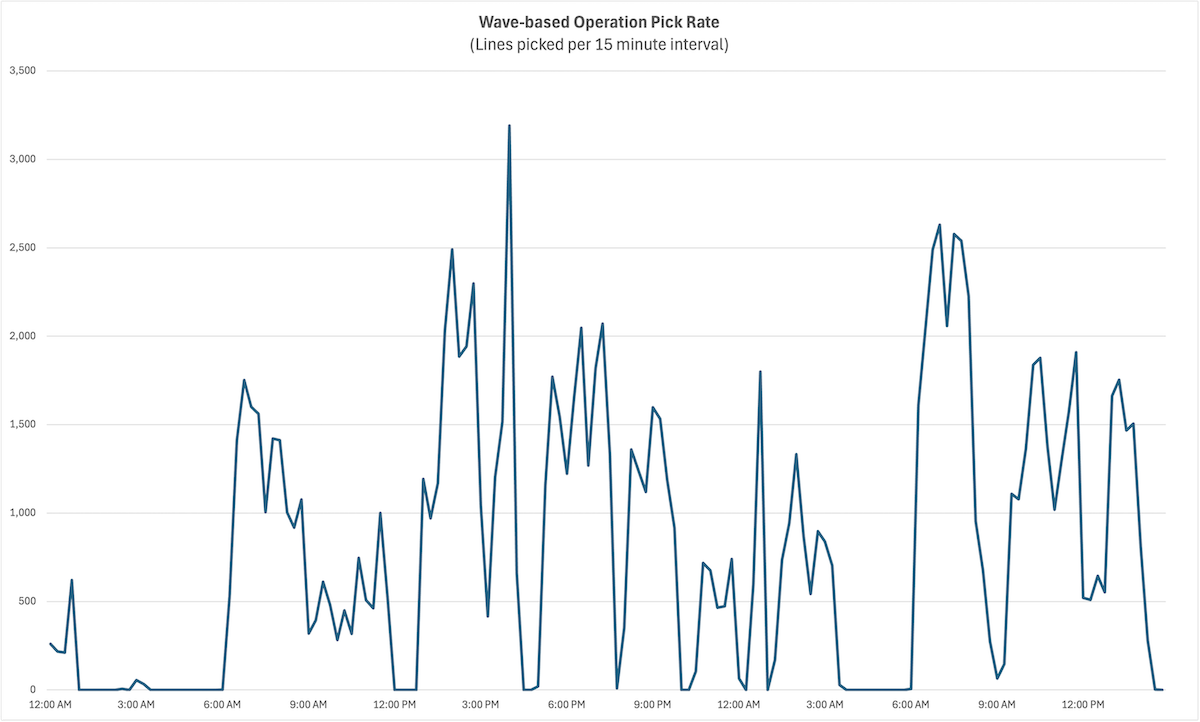
Batch and pick path optimizers work by optimizing the orders in a wave to maximize SKU affinity and minimize walking and time between picks in the warehouse. These tools work very well at the start of a wave but are inflexible and struggle to maintain efficiency at the end of waves when there are less orders to optimize. As the number of orders in the order pool decreases, grouping orders with high SKU affinity becomes harder. As a result, the distance walked and time between picks increases and productivity declines. Further, all the orders with low volume SKUs can end up being excluded from early waves, resulting in very inefficient end-of-day waves full of orders with very low SKU affinity and long walks between picks. Because most wave-based warehouse software must pre-allocate resources to process the orders in a static batch, such as inventory, sort locations, and pickers, all orders in a wave must be processed and any exceptions resolved before the next wave can begin. Making changes requires replanning the batch, and subsequent batches. Many facilities can end up with period of low worker and resource utilization at the end of a wave as the staff wait for the final orders in the wave to complete and next batch re-planned. Losing 20% to 40% of labor productivity to wave transitions is typical.
Improving Flexibility, Agility, and Utilization with Waveless Fulfillment
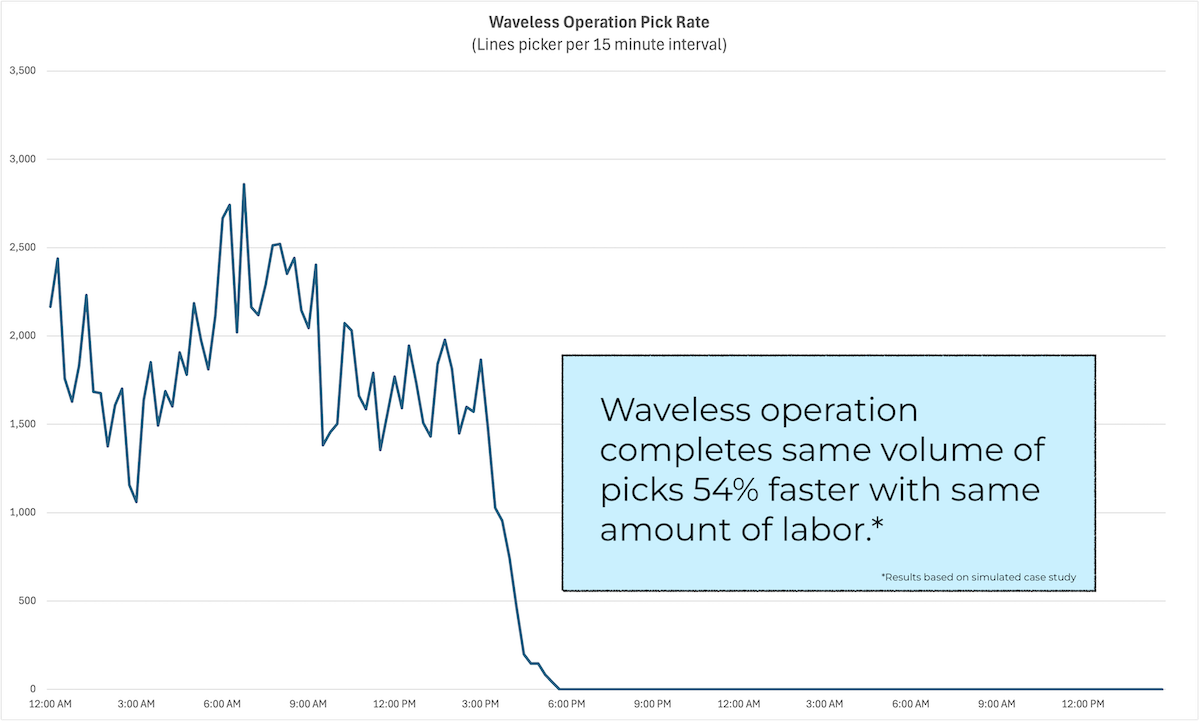
Waveless fulfillment helps warehouse operators improve flexibility, agility, and resource utilization by modernizing how orders are processed in a warehouse to meet today’s e-commerce and omni-channel retail demands. Waveless solutions like Fulfillment Engines process very large, dynamic batches of orders in a continuous flow. As soon as an order completes, a new order is activated and added to the active batch. Activating new orders in a continuous flow optimizes resource utilization and eliminates the waste from static batch transitions. Further, activating new orders continuously and using waveless picking helps maintain pick density and avoid long walks between picks. Higher resource utilization and picking efficiency helps lower labor costs by at least 20% compared to typical, wave-based operations.
Waveless fulfillment also helps reduce delays and impacts from exceptions. In a wave-based operation, all the exceptions in a wave must be resolved before the wave is closed out. This means a single order with an exception can hold up all the orders in a wave, and delay processing of all orders in subsequent waves. In a waveless operation, there are no wave dependencies between orders so other orders are not unnecessarily delayed when there are exceptions. For example, if there is a late replenishment, only orders with the impacted SKU are delayed. New and active orders without the SKU continue processing.s.
Reverse Loading of Trucks for Store Replenishment using Waveless Fulfillment
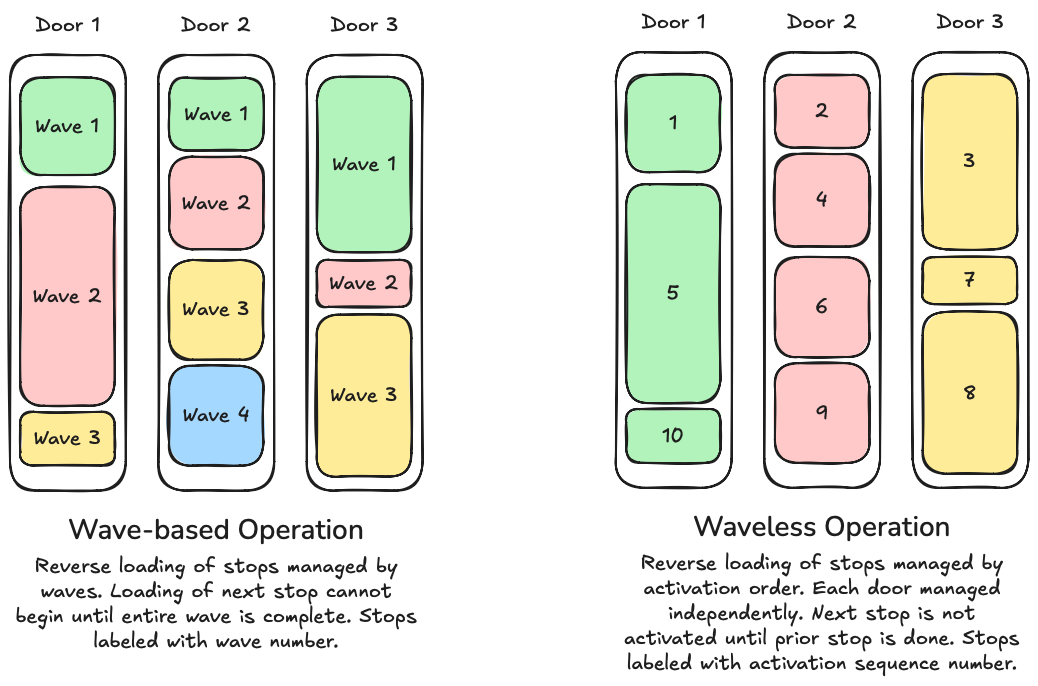
A common misconception about waveless is that it doesn’t work well for reverse loading of trucks for store replenishment use cases. This is not true. Rather than the traditional wave-based approach of creating waves of orders that span all the dock doors to guarantee layering orders in reverse stop sequence, a waveless process treats each shipping door for a truck independently. Orders for each door are still activated in reverse order to guarantee correct sequencing. Waveless fulfillment just eliminates having to wait for order processing at other doors to complete before starting to process picks for the next stop.
If you have more questions about waveless fulfillment, contact us, or check out Fulfillment Engines CEO Arturo Hinojosa’s blog post on Frequently Asked Questions about Waveless.