Overview
Fulfillment Engines Order Fulfillment helps you optimize orchestration of waveless, continuous flow order fulfillment.
What are the fulfillment challenges with traditional and wave-based warehouse systems?
Traditional and wave-based warehouse systems struggle to optimize fulfillment operations for a variety of reasons, including:
Inflexibility
Traditional and wave-based tools rely on pre-determined plans to orchestrate fulfillment. These plans can get out of sync with reality quickly and continue diverging with conditions on the floor as the day goes on. Wave-based warehouse management systems (WMS) and warehouse execution systems (WES) software struggles to adapt plans in real-time due to all the interdependencies across fulfillment processes. Inventory allocations to specific orders, worker task assignments, and order consolidation locations are all pre-determined and either cannot be or are very hard to change once a wave begins.
Difficulty handling dynamic and unexpected order profiles
Dynamic and unexpected order profiles challenge existing processes and automation equipment. When systems are designed for “predicated order profiles,” deviations from the expected order profiles can create bottlenecks and delays. For example, running out of capacity in one part of the facility while another part of the facility is underutilized.
High costs and shipping delays caused by exceptions
Traditional and wave-based warehouse systems pre-determine resources such as inventory allocation to specific orders and order consolidation locations. As a result, adapting to exceptions such as short picks and late replenishments isdifficult and can delay orders. In addition, because most warehouse systems only provide recommendations and dashboards, supervisors waste too much time investigating and resolving exceptions manually.
Supervisor decision fatigue and bottlenecks
Most WMS and WES tools offer real-time visibility via dashboards, but supervisors still need to synthesize the data quicklyon their own to make dozens of decisions to keep operations on track and resolve issues. On top of investigating exceptions, tracking facility performance and operational risks, supervisors are also responsible for figuring out how to release work, when and how to move people between functional areas, and which tasks to reprioritize to meet deadlines. Putting all these low-level tactical decisions on supervisors creates operational bottlenecks and facilities that are reliant on tribal knowledge and bespoke processes.
Low labor utilization
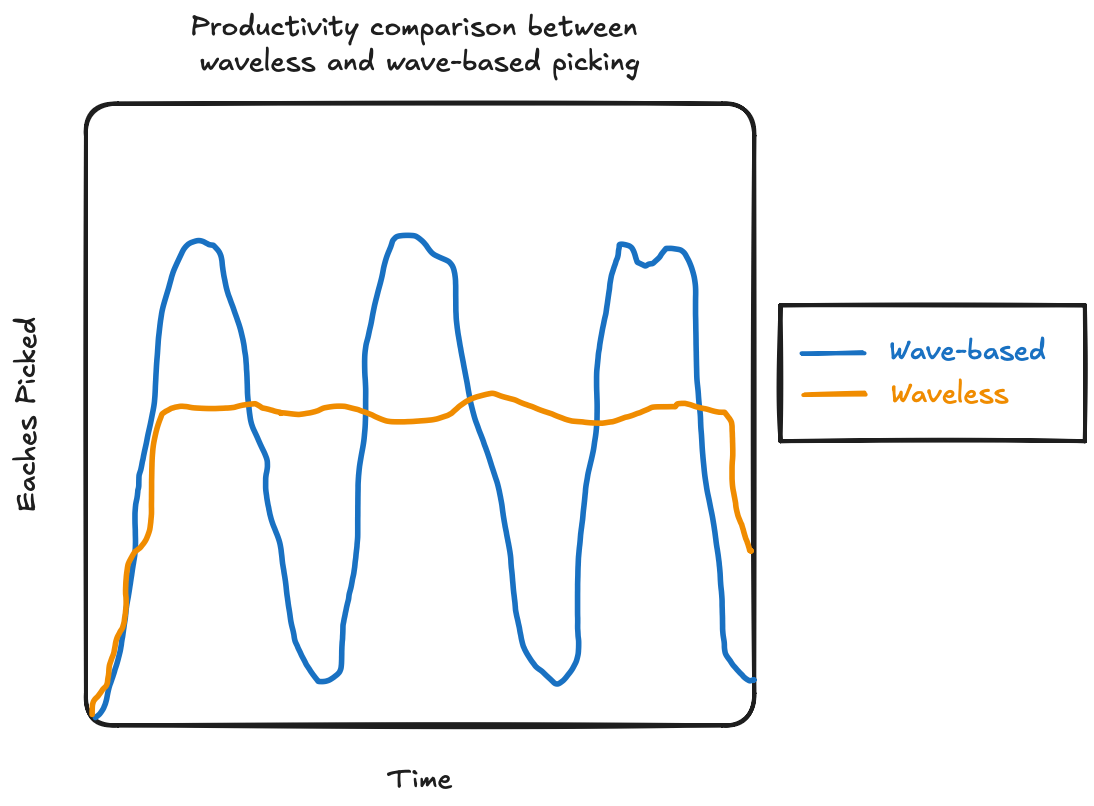
In a typical distribution center, labor efficiency is high, but labor utilization is low. Workers can spend 20% to 30% of their time sitting idle waiting for batch transitions and work hand-offs to complete.
What is Fulfillment Engines Order Fulfillment?
Fulfillment Engines is the most flexible warehouse execution system (WES) for e-commerce retailers and third-party logistics (3PL) providers. Fulfillment Engines Order Fulfillment helps retailers and 3PLs optimize orchestration of the order fulfillment process from picking through sortation (if necessary), consolidation, and packing.
Fulfillment Engines supports order, cart, cluster, and batch picking. Fulfillment Engines also offers configurable order release and prioritization criteria to allow customers to incorporate their own business logic and rules. Orders can be consolidated at putwalls or in automation equipment such as unit sorters.
What are the benefits of Fulfillment Engines Order Fulfillment?
Increase flexibility and agility
Fulfillment Engines offloads dozens of tactical decisions from supervisors to save time, remove process bottlenecks, and reduce supervisor’s administrative overhead. Fulfillment Engines monitors real-time conditions in the facility continuously to optimize and align resources to ship all orders on-time and correct. And, because Fulfillment Engines is designed to optimize manual operations, it adapts your people and processes to any order profile changes on the fly efficiently.
Manage exceptions efficiently
Fulfillment Engines proactively detects and resolves many common types of exceptions automatically, including short picks and late replenishments. Faster detection means exceptions can be fixed faster by the software. Fulfillment Engines waveless order processing also allows Fulfillment Engines to isolate the impact of exceptions to avoid unnecessary delays.
Lower labor costs between 20% and 40%* in just weeks
Fulfillment Engines optimizes labor utilization to minimize idle time using waveless order processing and continuous order flow orchestration.
*20% to 40% savings based on typical facility performance. Fulfillment Engines can help provide a tailored estimate for your specific distribution center as part of a no-cost simulation analysis.
What are the key features of Fulfillment Engines Order Fulfillment?
Automated Exception Handling
Fulfillment Engines can proactively detect and correct exceptions automatically and in real-time, with little or no supervisor involvement required.
The system is continuously checking for many types of common exceptions, including:
- Short picks
- Late replenishments
- User errors (incorrect SKU or location scans)
- Missing or lost totes or cases
- Abandoned resources, such as equipment or workstations
Self-balancing Labor Management
Fulfillment Engines aligns labor and resources in real-time to ship all orders on-time and correct.
When the system detects that a functional area is falling behind or getting out sync, it can reassign qualified workers automatically to re-synchronize operations. Fulfillment Engines has built-in guard rails to protect against over-rotating workers and low-ROI changes. Warehouse supervisors can create profiles for workers that manage which roles, functional areas, and pick zones workers can operate. Fulfillment Engines not only eliminates worker idle time, it prioritizes labor resources on the tasks needed to ship orders on time instead of lower priority filler tasks.
Waveless Order Processing
Fulfillment Engines uses continuous flow order processing to improve operational agility and optimize resource utilization.
Waveless order processing eliminates delays from wave transitions and can improve resource utilization by 20% or more. As a result, you can increase facility throughput without adding people or expensive automation equipment, or process the same number of orders with less people.
Waveless order processing also improves agility because resources are not pre-determined. The system assigns resources such as workers, inventory, and order consolidation locations in real-time based on the current conditions and priorities in the distribution center to ensure all orders ship on-time and correct.
Enhanced Bucket Brigades
Fulfillment Engines offers orchestration of self-balancing bucket brigades to shorten pick times and protect against congestion and blockage in pick areas.
Fulfillment Engines enhanced bucket brigades go beyond traditional bucket brigades to improve picker traffic management and productivity. Pick zones expand and contract in real-time based on the picker's workload and current velocity to maximize overall workforce productivity. Enhanced bucket brigades don't require buffers or create picker idle time to hand-off or receive work.
In addition, Fulfillment Engines enhanced bucket brigades improve upon traditional bucket brigades by continuously monitoring pick zones, workers, and workloads for potential congestion and blockage risks, and proactively creating separation between pickers when necessary to avoid congestion and blockage issues.

How does Fulfillment Engines Order Fulfillment integrate with a WMS?
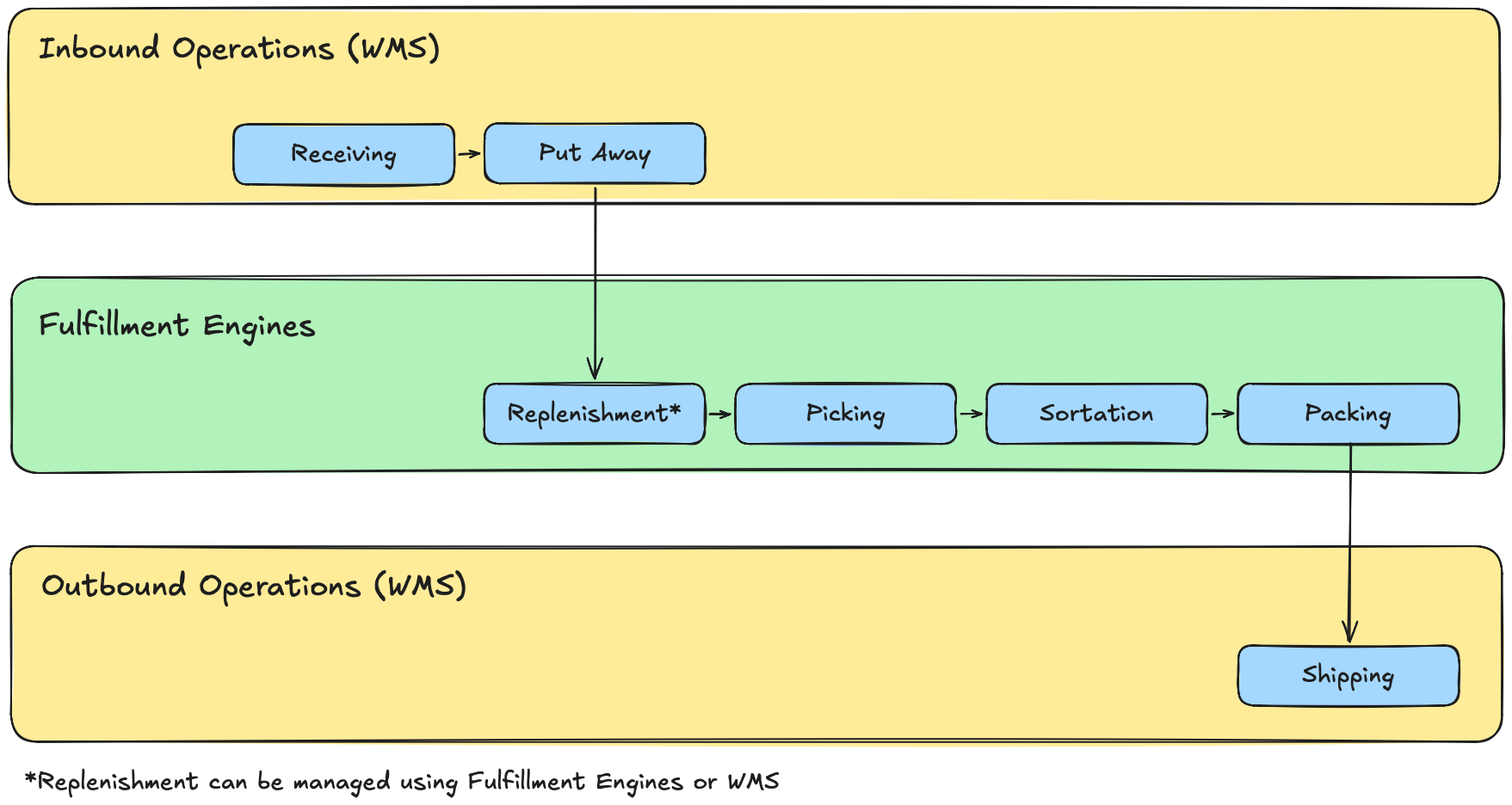
Fulfillment Engines integrates with any existing commercial or in-house WMS in a similar fashion to pick to light systems. The WMS continues to own inbound receiving and shipping. Order and inventory data is exported from the WMS and imported in Fulfillment Engines using Fulfillment Engines’ APIs. Fulfillment Engines takes over fulfillment execution, including picking, sortation, consolidation, and packing. Fulfillment Engines can also take over replenishment, if desired.