How to prevent delays and exceptions from late replenishments?
August 7, 2026
You will find many articles and posts that mention the challenges that distribution centers face with the replenishment function (reserve to forward). They often recommend ways of changing other functions to accommodate the limitations of how traditional wave-based replenishment systems work today.
This blog takes a different approach. Not only do I summarize the challenges, but I present a new waveless replenishment solution that addresses the underlying replenishment issues to unlock new levels of productivity and performance in your warehouse operations.
Happy reading!
What is replenishment?
Replenishment is the process of moving inventory from the reserve area of the warehouse to the forward picking area. Inventory in the reserve area is typically stored in full cases or pallets that come directly from the manufacturer or supplier. During replenishment, full cases are retrieved by workers or mini loads and sent to the forward picking area so pickers can select individual eaches for orders. In simple terms, you can say that reserve is optimized for storage and forward is optimized for picking.

What are the common challenges with replenishment?
The replenishment process can be one of the most, if not the most, disruptive process in a distribution center.
In operations where picking for orders is allowed to begin before the replenishments for those orders are completed, you can see many short picks. Short picks happen when there is insufficient inventory in the forward pick area for a picker to fulfill all their assigned demand. Short picks develop because the pickers get ahead of the replenishments due to either picking faster than expected or late replenishments caused by delays. Dealing with exceptions from late replenishments and short picks can be distracting for warehouse supervisors, who then need to investigate and decide how to the solve the issues (e.g., force complete the orders, send a runner for a hot replenishment, etc.).
Wave-based systems try to prevent short picks by requiring all replenishments for the orders in the wave need to be completed before picking for the wave starts. This ensures there is sufficient inventory available in the forward pick area to meet demand for the wave. However, the downside of this approach is waiting for all the replenishments to complete can delay order processing and result in idle pickers waiting for the replenishments to complete and the next wave to begin.
Late replenishment can also negatively impact waveless operations. In many of the waveless operations I know, even though the fulfillment process is waveless (e.g., there is a continuous flow of activated orders for picking), the replenishment function is still a wave-based process managed by the WMS. Often in these hybrid waveless operations, late replenishments are the main driver of late orders.
So, what can operators do to prevent delays and exceptions from late replenishments? I believe waveless replenishment can be an easy to implement solution.
What is waveless replenishment?
The concept of waveless fulfillment has been around and well accepted for many years. With waveless fulfillment, new orders are activated continuously as active orders are completed. Waveless fulfillment can reduce labor costs by 20% to 40% for a typical warehouse compared to traditional wave-based fulfillment by eliminating idle time from wave transitions. We can extend many of the same waveless principles and benefits to the replenishment function.
How does waveless replenishment work?
Instead of replenishing a pre-determined set of SKUs for a fixed set of orders like wave-based replenishment systems, waveless replenishment continuously triggers replenishment of the SKUs needed for the upcoming order(s) that are next to be activated.
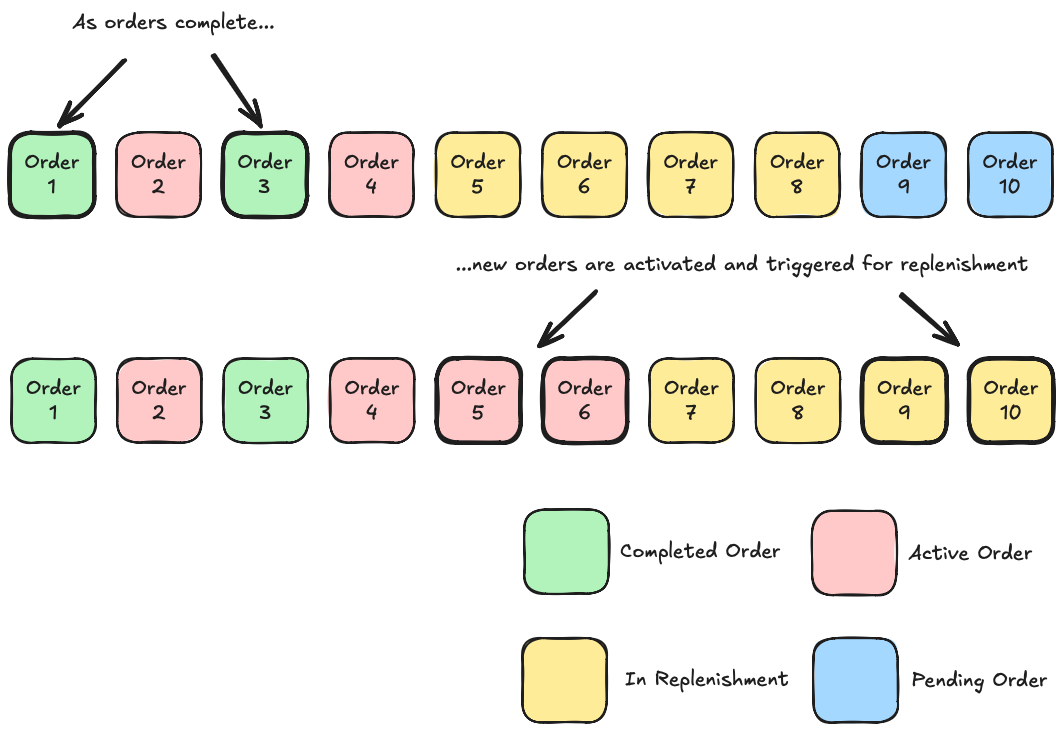
As order(s) complete and the next order(s) are activated for fulfillment, the system checks which SKUs are needed for the next future order(s) (the new next orders to be activated) and queues the necessary replenishment tasks for those SKUs in the same sequence in which the order(s) will be activated for fulfillment. Cases are still retrieved in batches, but cases are added to the batch dynamically in the order that they will be needed.
What are the benefits of waveless replenishment?
By analyzing upcoming demand continuously in real-time and proactively triggering replenishment of needed SKUs in advance of the orders being activated, the risk of late replenishments is minimized. At the same time, because there are no pre-determined waves, there are no order processing delays or idle pickers caused by waiting for replenishment tasks to complete. As a result, there are fewer exceptions to resolve, saving supervisor time.
In addition, waveless replenishment minimizes the reaction time to service high-priority replenishments, in a similar way as waveless fulfillment reacts faster to high-priority orders. Real time processes, like waveless fulfillment and waveless replenishment, can detect exceptions earlier than quasi-real time or non-real time processes; they also can react and take corrective actions much faster. Faster detection and faster correction are major advantages of waveless replenishment.
Next steps
Fulfillment Engines offers a highly intelligent, waveless replenishment solution by leveraging its real-time decision-making engine and advanced analytics. We analyze dozens of signals to proactively detect late replenishment issues and adapt your operations in real-time to prevent delays. Our design and APIs can support integration with your existing commercial or in-house WMS to allow your WMS to continue managing inbound receiving and inventorywhile delegating replenishment task orchestration and management to Fulfillment Engines. We also support SKU replenishment to single, multiple, and dynamic locations.
Contact us to learn more about waveless replenishment and how Fulfillment Engines can help you prevent delays and exceptions from late replenishments.
About the Authors

Arturo Hinojosa
Founder and CEO, Fulfillment Engines
Arturo is the product and logistics visionary behind Fulfillment Engines. He is a materials handling industry veteran with over 30 years of experience at industry leaders such as Dematic, Reddwerks, and Fortna. Arturo is a vocal evangelist of the benefits of waveless order processing and applying advanced operations research techniques to solve customer problems. He has a Masters in Operations Research from Stanford University.