Fulfillment Evolution of E-commerce Start-ups
May 14, 2026
Since the start of E-commerce 25 years ago, creative entrepreneurs have started many E-commerce companies. A good number of these companies have become successful and grown at a good pace. Initially, these companies needed to fulfill a small number of orders, from a limited number of SKUs. Then, when they become successful, they experience fast growth.
Once these entrepreneurs outgrow their kitchen tables and garages, most start scaling their operation with simple fulfillment processes. They may have 3 or 4 pickers filling orders with pick carts using a conventional cluster picking approach, as shown below in figure 1. In this basic process, pickers cluster pick a set of orders, maybe 20 or 30 orders, from beginning to end in a racetrack tour, traveling with the pick cart to all locations that have product demanded by the orders.
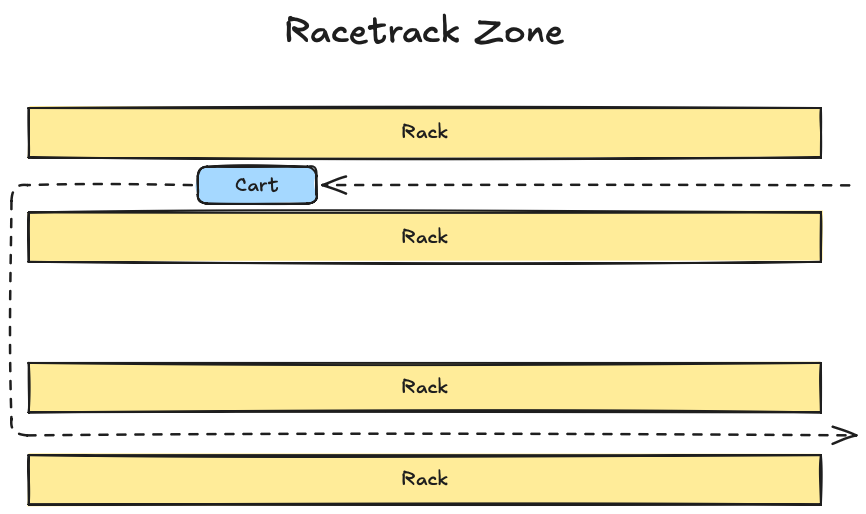
As the company grows, this simple process starts getting into problems. As the volume of orders to process increases, more pickers need to be added. Congestion can then become a problem in the rack area. If the number of SKUs increases, more pick paths need to be added on the ground, or the company needs to start going vertical. As a result, walking between picks becomes too long and/or carts cannot practically travel between vertical levels.
At this point, two of the most common options to continue scaling are either a zone routing process or a batch pick to put process.
Zone Routing Process
In a zone routing process (also called serial zone picking) the pick area is divided into pick zones. Each pick zone has one picker permanently assigned to the zone. Conveyor connects all the pick zones together. The conveyor transports order containers to the pick zones that have inventory needed for the order; pick zones that do not have inventory for the order are skipped.
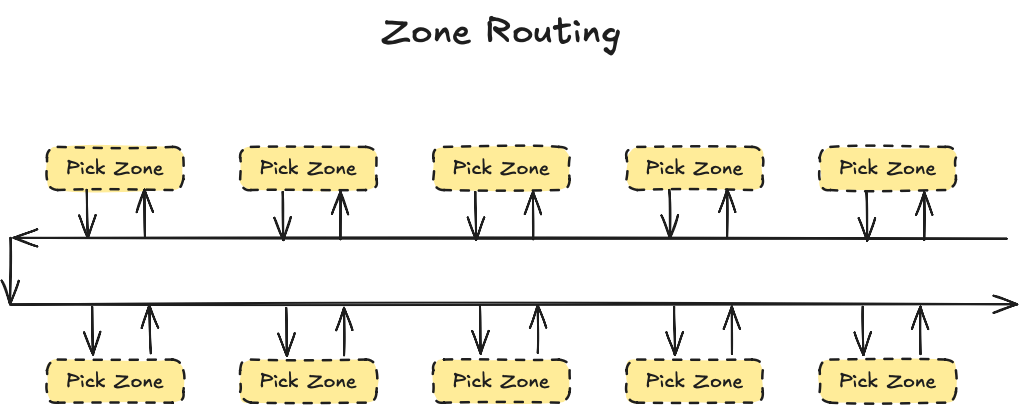
The main benefit of zone routing is that it reduces picker congestion as the number of pickers grows as there are never more than one picker in each pick zone. Pickers also do not need to transport order containers across pick zones that do not have products for the orders. The conveyor takes care of that.
However, the trade-offs with zone routing are:
- Workload balancing is difficult with static zones. Due to the randomness in order demand, some pick zones go idle while others are overloaded with work at different times of the day.
- Long walks. Typical E-commerce orders only have between 2 to 3 items. As a result, pickers only need pick one item from a pick zone. The average walk for a pick is half the length of the zone. Even when the picker is always busy, pick rates are not very high.
- Limited by conveyer capacity. The required throughput capacity of the conveyor is one merge and one sort for each pick line to be processed. This requirement limits the upper capacity that the system can scale up to.
Batch Pick to Put Process
In a batch pick to put process, pickers pick with pick carts. The pick carts carry batch pick totes. Each pick tote in the cart is destined to a putwall and contains product for multiple orders that are being consolidated at the target putwall.
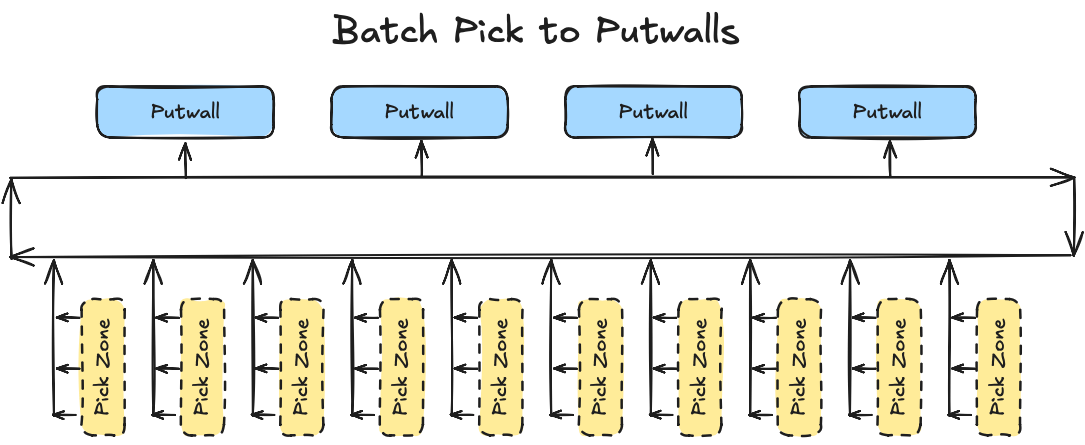
As mentioned before, a pick cart cluster picking orders can pick for 20 to 30 orders per tour. A pick cart batch picking orders for put walls can pick for 200 to 300 orders per tour – 10x more.
The benefits of batch pick to put are:
- Much higher pick density reduces the labor that you need in the pick zones.
- Orders do not need to be completed in a single pick cart. Product for the same order can come from different pick carts in different pick zones to be consolidated at the putwall.
- Scales up well to 7,000 units per hour and 20,000 SKUs.
- Delays the need for expensive automation equipment, which on top of costing hundreds of thousands to millions of dollars, can take months or years to roll-out and requires highly trained, specialized technical support staff to maintain.
The main challenges with this process are:
- Extra handling of the items at the putwall. That said, because of the higher pick density and the higher put rates that you can get from putwalls, you may need less labor with this process. Nevertheless, operators need to evaluate their specific situation to make a sound decision (psst - we can help!).
- Operation of putwalls has been traditionally difficult. Batch transitions are long and inefficient. Managing multiple inbound queue buffers for the putwalls gets complicated. Exceptions have painful consequences.
Batch pick to put processes operated with Fulfillment Engines eliminate the traditional batch transition and queue management issues. With waveless processes, batch transitions are eliminated, multiple inbound buffers are not needed, and exceptions are automatically handled by the software with little impact on the operation.
If you have reached the limit of your cluster order picking operation and are ready for your next evolution leap, contact Fulfillment Engines to get your no-cost assessment and learn how we can help.
About the Authors

Arturo Hinojosa
Founder and CEO, Fulfillment Engines
Arturo is the product and logistics visionary behind Fulfillment Engines. He is a materials handling industry veteran with over 30 years of experience at industry leaders such as Dematic, Reddwerks, and Fortna. Arturo is a vocal evangelist of the benefits of waveless order processing and applying advanced operations research techniques to solve customer problems. He has a Masters in Operations Research from Stanford University.